It’s there in the ad, in capitals: GARAGE FIND. Stood for a year. Ran when parked, just needs a battery. It’s £700, and you’ve always fancied a project.
Sometimes it’s true. But a year standing still does things to a car that a new battery won’t fix, and some of them only show up after you’ve paid. Here’s what standing does, what to check, and how to get it home legally.
What a year standing still does
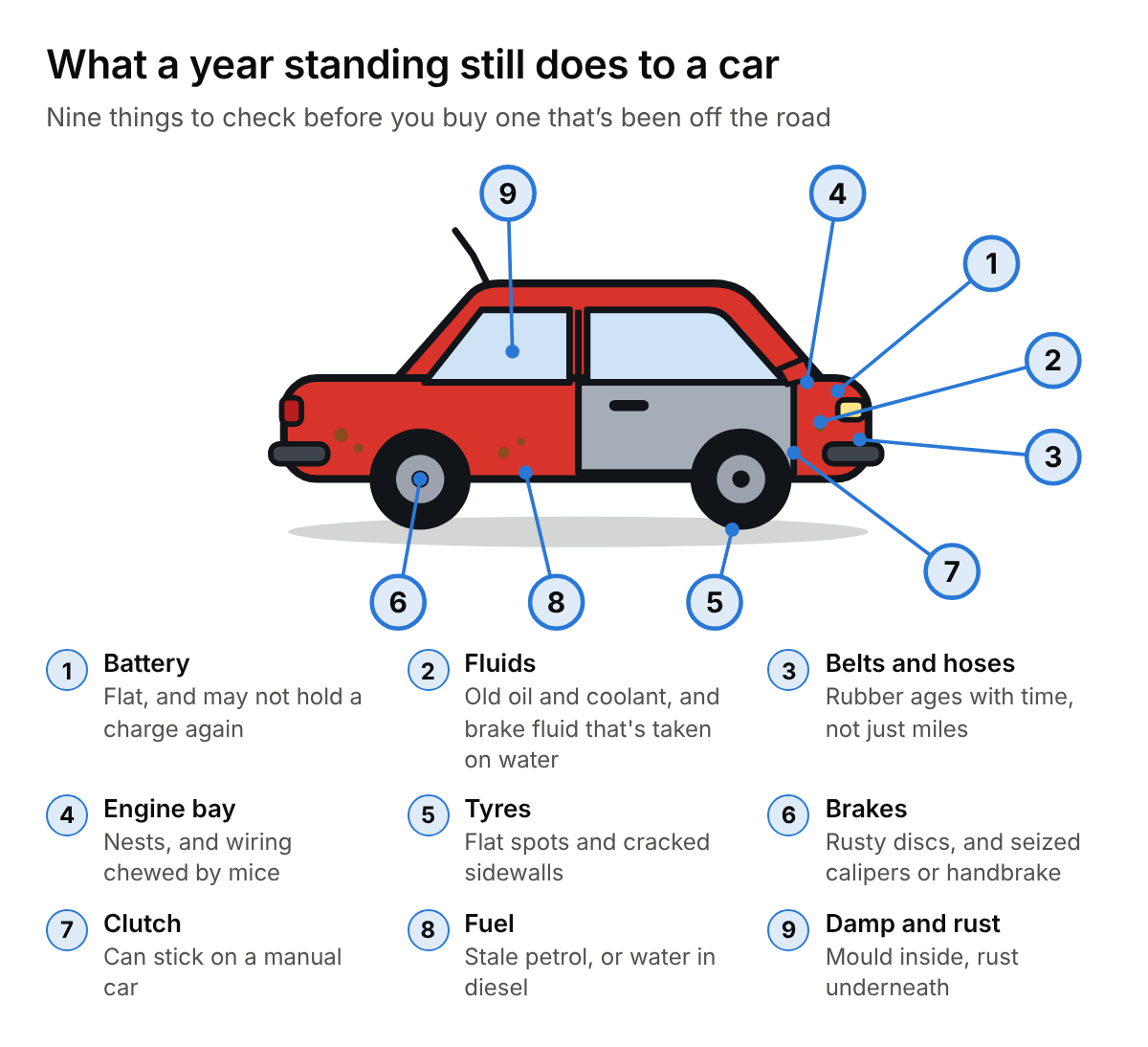
- The battery goes flat, and one that’s been left flat for months often won’t hold a charge again.
- Fluids age even when the car doesn’t move. Brake fluid takes on water over time, and old oil and coolant want changing before the car’s used again.
- Belts and hoses age with time as well as miles, which is why many makers give a timing belt change in years as well as miles.
- The engine bay is a cosy place for mice, and some chew through wiring.
- Tyres lose pressure, can develop flat spots where they’ve sat, and the rubber can crack, however much tread is left.
- Brakes: the discs rust, and the calipers or the handbrake can seize, especially if it was left with the handbrake on.
- The clutch can stick on a manual car that’s stood in the damp.
- Fuel can go stale, and diesel can take on water in the tank.
- Damp and rust: a car that’s stood outside, especially on grass, can rust underneath and grow mould inside.
None of this is a reason not to buy. It’s a reason to know what you’re paying for.
Before you go: check the story
- Ask why it was parked, where it stood (a garage, a drive, grass or the street), when it last ran, and whether it’s been started or moved since.
- Check the MOT history. Our free look-up shows the date and the mileage of every test. The story should match: a car that’s stood for a year shouldn’t have passed an MOT six months ago.
- Run a history check. A year off the road doesn’t clear outstanding finance, a write-off record or a stolen marker. A Premium check covers all three.
- Expect the paperwork to show it. A car kept off the road without tax should have a SORN (Statutory Off Road Notification), and its MOT has probably run out (GOV.UK).
When you see it
- Ask for it not to be started before you arrive, and for nobody to try until the oil and coolant have been checked.
- Tyres: look for cracks in the sidewalls and flat spots.
- Brakes: a light film of rust on the discs usually cleans off once the car’s driven. Deep pitting or heavy corrosion can mean new discs. Check the handbrake releases and the wheels turn.
- Under the bonnet: look for nests, droppings and chewed wires, and at the oil and coolant.
- Underneath: leaks, and rust on the sills and the floor.
- Inside: a damp or musty smell, wet carpets or mould.
- Moving it: if it’s untaxed or out of MOT, any test is on private land, not the road.
Our guide The £850 Question covers every other check, from the log book’s serial number to the VIN.
Price in the recommissioning
“Ran when parked” tells you about the past, not today. A car that’s stood for a year usually needs at least a battery and a service with fresh fluids, and often tyres and brake work before its MOT. Add the belts if they’re due by age.
Our free Profit Calculator adds it all up, with a buffer for the surprises. Every figure is your own estimate, and nothing you type is saved.
Getting it home
- A SORN doesn’t pass to you. It ends when the car is sold, and you can’t take over the last keeper’s. Tax it, or make your own SORN and keep it off the road: in a garage, on a drive or on private land (GOV.UK).
- To drive it home, it has to be taxed, insured, roadworthy and have a valid MOT where it needs one.
- The exceptions are narrow. A SORN car can only be driven to a pre-booked MOT test. A taxed car whose MOT has run out can also go to a garage booked to fix it (GOV.UK). Either way, it has to be insured and roadworthy. After a year standing, a trailer or transporter is usually the safer way home.
Your rights
- From a trader, the car must match its description and be of satisfactory quality, allowing for its age, mileage and price, but not for faults the seller pointed out before you agreed to buy. So a trader’s ad should say how long it’s stood and list what’s known. Buying for yourself, you can usually cancel within 14 days of getting it if the sale was agreed online, through an auction or away from the trader’s premises.
- From a private seller, the car must match its description. Satisfactory quality doesn’t apply.
- Screenshot the ad. “Ran when parked” and “just needs a battery” are part of its description.
Selling one?
- Say how long it’s stood, and list what you know.
- Don’t guess the fix. “Doesn’t run, cause not diagnosed” is safer than “just needs a battery”. If the guess is wrong, the buyer can say it wasn’t as described.
- If it can’t be driven, tick “Not roadworthy” and say it leaves on a trailer or transporter.
Our guide Failed Its MOT? Don’t Scrap It Just Yet covers the rules on selling a car that can’t be driven.
The checklist
Before you go
- Why, where and how long it stood, and when it last ran
- The MOT history matches the story
- A history check for stolen, write-off and finance records
When you see it
- Oil and coolant checked before it’s started
- Tyres checked for cracks and flat spots
- Discs, calipers and handbrake checked
- Engine bay checked for nests and chewed wiring
- Underneath checked for leaks and rust
- Inside checked for damp and mould
Before you pay
- Battery, fluids, tyres, brakes and belts priced in
- Taxed and insured, with a valid MOT, or a trailer or transporter booked
- Your own SORN made, if it’s staying off the road