It’s Friday night, and you’ve found it. A 2009 hatchback, 98,000 miles, a year’s MOT, £850. The photos look clean, and the seller says it “drives lovely”. You could have it on your drive by Sunday.
Most cheap cars are exactly what they look like. But a cheap car is also where problems like to hide: a mileage that’s been wound back, a write-off nobody mentions, finance still owed, or a log book that belongs to a different car. None of that shows up in the photos.
Here’s how to spend the next 48 hours, so that whatever happens on Saturday, you don’t pay £850 for someone else’s problem.
Friday night: ten minutes on your phone
Ask the seller for the registration. A genuine seller won’t mind. Then run the free checks:
- Does it match? DVLA’s records give the make, colour, and tax and MOT status (GOV.UK). A blue car in the ad and a silver one on DVLA’s records is a question worth asking.
- The MOT history lists every test since 2005, with the mileage at each one (GOV.UK). Read it like a diary. If the car had done 81,000 miles by 2019 and 74,000 by 2021, it hasn’t been driving backwards. A long gap between tests needs explaining too, and so does a list of rust or brake warnings that grows every year.
- Recalls. Check for an outstanding safety recall, using the recall checker linked from GOV.UK’s vehicle checks.
- Low emission zones. If you’ll drive into Glasgow, Edinburgh, Dundee or Aberdeen, a car that doesn’t meet the standard gets penalty charges. Petrol cars from 2006 and diesels from September 2015 are generally fine, and the vehicle checker linked from Traffic Scotland’s guide will confirm it. In England, London’s ULEZ and the clean air zones in Birmingham and Bristol charge older cars (TfL, GOV.UK).
What no free check can tell you is whether the car is stolen, written off or still on finance. If there’s finance owing, the finance company may still own the car, and you could lose it. Only a paid history check covers those, and even then, a clear result means nothing was on record when you checked. It isn’t a guarantee.
If it’s been written off
Insurers put written-off cars into categories (GOV.UK):
| Category | What it means |
|---|---|
| A | Can’t be repaired. The whole car must be crushed |
| B | Can’t be repaired. The body shell must be crushed, but parts can be salvaged |
| S | Structural damage. It can go back on the road once repaired to a roadworthy condition |
| N | Non-structural damage. It can go back on the road once repaired to a roadworthy condition |
Cars written off before October 2017 were put in Category C or D instead. A repaired Category S or N car can be good value, but GOV.UK’s guide suggests an independent inspection for structural damage and an insurance quote before you buy. Tell your insurer afterwards, or a claim could be turned down.
Saturday, 10am: the address and the log book
Where you see the car tells you a lot. A private seller should show it at home, at the address on the log book (V5C). A trade seller shows it at their business, or delivers it. If the plan is a supermarket car park, or “my cousin’s selling it for me”, slow down.
Ask for the log book before you look at the car:
- It should have a “DVL” watermark.
- Check the serial number. If it’s between BG8229501 and BG9999030, or between BI2305501 and BI2800000, the log book may be stolen. Don’t buy, and call the police when it’s safe to (GOV.UK).
- For a private sale, the name and address should be the seller’s.
- The registration, the VIN and the engine number should all match the car. The VIN is usually at the bottom of the windscreen, on a plate in a door frame and stamped into the body.
While you’re at it, ask for the service history, old MOT certificates, receipts and the spare key. A thick folder of receipts doesn’t make a car good, but it shows someone cared about it.
Bonnet up, engine cold
Ask the seller not to start the car before you arrive. A cold engine hides less, so watch for smoke and listen for knocks or rattles as it starts.
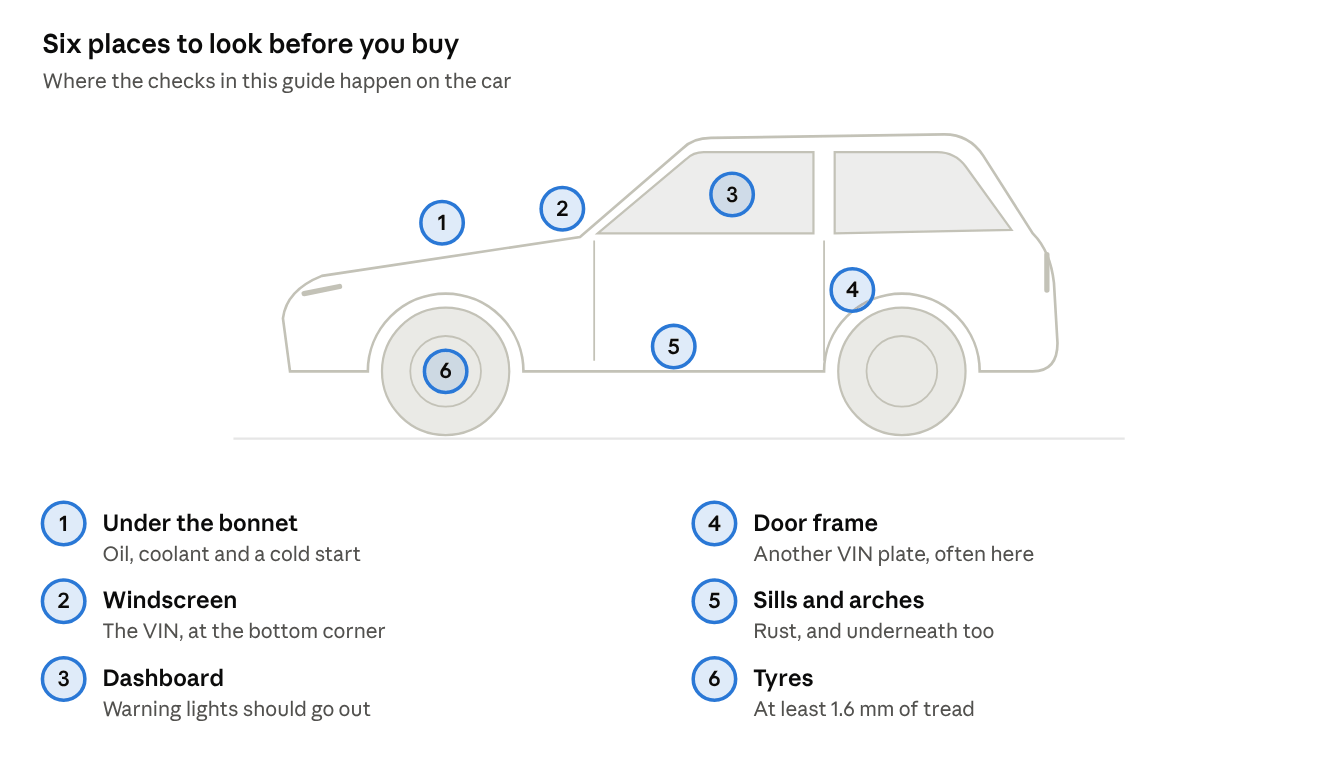
- Warning lights should come on with the ignition and go out once the engine runs, apart from the handbrake light (Highway Code).
- Tyres need at least 1.6 mm of tread across the central three-quarters, all the way round. Uneven wear can mean tracking or suspension problems.
- Rust. Look at the sills, wheel arches and floor, and underneath if you can. Rust near the suspension or seat belt mountings is serious.
- Bodywork. Panels that don’t line up, or paint that doesn’t quite match, can mean accident repair.
- Under the bonnet. Check the oil and coolant levels. White, creamy sludge under the oil filler cap can be a sign of head gasket trouble, though short journeys can cause it too.
- Everything else. Try the lights, windows, wipers, heater and air conditioning.
The test drive
Any car on a public road has to be taxed, insured, roadworthy and MOT’d where it needs one, and that includes a test drive. You need to be insured to drive it, too.
On the road, notice whether it pulls to one side when you brake, which usually means a brake fault or wrong tyre pressures. A clutch that bites near the top of the pedal can be worn. Listen for knocks over bumps, and feel how the gears change.
If it isn’t road legal, hear it run, look it over, and let the price reflect it.
The handshake
If everything adds up, it’s time to talk money. What protects you depends on who’s selling:
| Your right | Private seller | Trade seller |
|---|---|---|
| The seller owns the car, or has the right to sell it, with any finance paid off | Yes | Yes |
| The car matches its description | Yes | Yes |
| It’s of satisfactory quality and fit for purpose, allowing for its age, mileage and price | No | Yes |
| 30 days to reject it if it’s faulty | No | Yes |
| 14 days to cancel a sale agreed online, through an auction or away from the seller’s premises | No | Usually |
Satisfactory quality doesn’t cover faults the seller pointed out before you agreed to buy. “Sold as seen” can apply to a private sale, but it never covers a car that doesn’t match its ad.
Then pay safely:
- No deposits. Never pay a deposit, or anything at all, before you’ve seen the car.
- Cash, in full, on collection. A trade seller checked by Save The Banger can also take a bank transfer, but only into the account shown on your reservation page.
- Never pay by PayPal Friends and Family, cheque, cryptocurrency, gift cards, a money transfer service or a payment link someone sends you.
- We never hold your money. Save The Banger never takes, holds or passes on payment for a car. Anyone asking you to pay us, or to use an “escrow” or “safe payment” service, is a scammer.
- Screenshot the ad. If your offer was accepted or you won an auction, you’ve agreed to buy as long as the car matches it.
Driving home, legally
The tax doesn’t come with the car. Before you turn the key:
- Tax it, using the green new keeper slip from the log book (GOV.UK).
- Insure it from the moment you drive away.
- Only drive it if it’s roadworthy and has a valid MOT where it needs one. If not, it goes home on a trailer or transporter.
Ad · Bought a car that can’t be driven home? Elite Chariots, based in West Lothian, collects and delivers cars and vans across the UK, including auction collections. elitechariots.com
The seller tells the DVLA about the sale. Your new log book usually arrives within 4 weeks, or 5 to 7 working days if the seller did it online. If it hasn’t come after 4 weeks, contact the DVLA before 6 weeks have passed (GOV.UK).
And that £850 hatchback? If it’s passed all of this, it’s probably exactly what it looked like on Friday night. Enjoy it.
The checklist
Friday night
- Registration from the seller
- Make, colour, tax and MOT status match the ad
- MOT history and the mileage at each test look right
- No outstanding safety recall
- Meets the low emission zone standard, if you’ll drive in one
- History check for stolen, write-off and finance records
Saturday morning
- At the seller’s home or business address
- Log book with a “DVL” watermark and a serial number outside the stolen ranges
- Registration, VIN and engine number match the car
- Starts from cold with no smoke, and the warning lights go out
- Tyres, rust, bodywork, oil and coolant checked
- Insured for the test drive
The handshake
- No deposit paid
- Paying in cash, or by bank transfer into the account on your reservation page for a checked trade seller
- Green new keeper slip in your hand
- Taxed and insured before you drive, or a trailer or transporter booked
Checks on Save The Banger
Our Car History Checks page looks up any car’s make, MOT and mileage at its last test for free, with its MOT history. For what the free checks can’t show, there are two paid checks:
- Basic, £4.99: keepers, plate and colour changes, scrapped, exported or imported markers, MOT history, a mileage check and the detailed spec.
- Premium, £9.99: everything in Basic, plus stolen-vehicle, insurance write-off and outstanding finance checks.
You can buy either from a car ad on the site, or on the checks page for any car, wherever you found it. You need a free account, and you must be 18 or over.
Buying a car to do up and sell on? Our free Profit Calculator works out what it’ll cost to get it on the road and what you could make. Nothing you type is saved. If you buy cars to sell on for profit, you count as a trade seller and need a trade account.
On Save The Banger, Category A cars can’t be advertised, and Category B cars only as parts. Category S and N cars, and cars written off as Category C or D before October 2017, must say so in the ad.
Sources
- GOV.UK: Check a used vehicle you’re buying
- GOV.UK: Check the MOT history of a vehicle
- GOV.UK: Insurance write-offs
- GOV.UK: Buying repaired written-off vehicles, a consumer guide
- GOV.UK: Vehicle registration, new and used vehicles
- GOV.UK: Clean Air Zones
- The Highway Code, Annex 6: vehicle maintenance, safety and security
- Traffic Scotland: What are low emission zones?